

Table of Contents
Tired of Quitting Your Art Routine?
So many times in my art journey, I’ve experienced a burst of motivation or an urge to create, but then, before I know it, my empty sketchbook just sits open on my desk for five days. And I know I’m not the only one.
Why is it that it’s so unbelievably hard to fall into a routine of doing something you love? You’d think it would be easy, right? Although I don’t have the answer to that question in this post, I might be able to make it a bit easier to build a routine that does stick, instead of being abandoned by the fourth day.
I promise it’s not entirely your fault. It’s not because you lack the talent or don’t have the willpower; it’s that the routines you’ve tried in the past set you up for failure. That art schedule you found on a YouTube video was made according to someone else’s routines, schedule, and energy levels, not yours.
In this post, I will show you how to create a consistent art practice by making your own art routine that fits your life and lasts, hopefully, long-term, as long as you put in the time and dedication. I can give you the framework, but you’ve gotta build it up.
Why Most Art Routines Fail
Like I said above, it’s not entirely your fault that your art routines have failed. You most likely just fell into one of these common mistakes, which made it feel impossible to stick to your plan:
Setting goals that are too big
Sure, it’s fun to imagine yourself creating art for an hour each day and releasing a masterpiece 1-2 times a week, but let’s be realistic here. Nobody has time for that; at least not yet.
No anchor habit or trigger
I’ve recently read this book, Atomic Habits by James Clear. It’s a book that focuses on building good habits and breaking bad ones; I highly suggest it. I’ve tried some of the techniques mentioned in the book in my own life, and I’ve got to say, it has genuinely helped me build better habits that I’ve been trying to build for months. One of the techniques he talks about is using an “anchor habit” or a “trigger habit”. This means to attach a habit you wish to create to a strong one you already have.
Lack of flexibility
We are so quick to forgive others for their minor mistakes, and yet when it comes to ourselves, we are so harsh. It is very important to allow yourself rest days or catch-up days in routines like these. If you do not, you will simply fail because you’ve allowed yourself no mercy. Life happens, unexpected circumstances occur, and busy days or weeks are normal. If you do not give yourself the flexibility you need, you will deem it as a failure, and it will be even harder for you to start the daily art routine over again from there.
Trying to copy someone else’s daily art routine instead of designing your own
I feel like we’ve already sort of touched on this. No one routine will suit everyone. It is impossible because of the millions of varying factors in everyone’s life. You must create a custom art routine for yourself.
The Artist’s Step-by-Step Guide to Lasting Creative Habits
- Start Tiny. You wouldn’t walk into the gym for the first time and try to deadlift 300 pounds; you’d start small and build strength, and increase the weight as your muscles adapt. It’s the same principle when building a routine. Instead of 2 hours of art a day, start with 10 minutes for a while until you build resilience. Then, as you grow stronger in your abilities, you can adjust.
- Anchor It to Something You Already Do. If you are a morning coffee or tea drinker, you could use this habit as an anchor or a trigger, so that every morning when you brew or enjoy your coffee/tea, you draw little doodles for the entirety of the time it takes you to finish your beverage. This is called habit stacking. You can use this in multiple areas of your life. Before bed and after brushing your teeth, do some colouring. During your lunch break at school or work, do a short anatomy study.
- Remove Friction. Another thing James Clear mentions in his book “Atomic Habits” is removing friction, aka making it as easy as possible. Keep your supplies out on your desk so that it’s a constant reminder and it’s easily accessible for when you’re ready. Prepare your supplies, your workspace, and your reference / plan the night before. Lastly, to make it even easier, consider having a “quick prompt list” to reference if you feel no inspiration or if you’re out of ideas.
- Add Variety to Prevent Burnout. Change it up! There’s no rule saying you must sketch every day, or you must colour a page every day. Mix up your week with some sketching, colouring, anatomy studies, colour studies, etc. I know you might have a goal to progress as quickly as possible in one area (e.g., portrait sketches), but sometimes doing the same thing over and over again, every day, can get tiring and boring fast. Avoid this by switching it up!
- Build in Rest Days. Schedule at least 1-2 rest days throughout your week. If you feel you need more than that, then go for it! There shouldn’t be a set standard for how much artists need to create in a week, so if you have three creative days and four rest days, then that is still okay! Remember: even slow progress is better than no progress, and I don’t know about you, but if I don’t have any kind of daily art routine, most of the time I don’t end up making art. Even if I had a routine to make art two days out of the week, for even as little as 10 minutes each day, there’s a chance that might still be more creative time in my week than there would have been without that art routine.
A Realistic Art Routine For Consistency
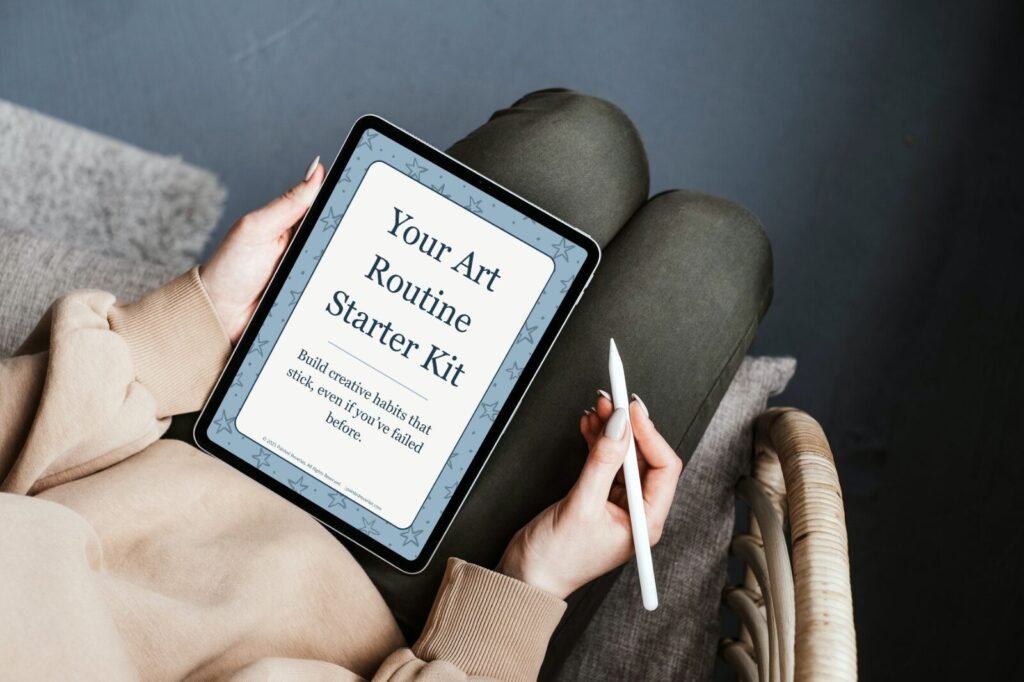
Here, I will include a sample daily art routine, but further down, if you’re interested, I have a free, full Art Routine Kit for all of you who would like an easy, fill-in-the-blank style planner. It’s worth checking out!
Monday: 10-min doodles while coffee brews
Tuesday: 20-min anatomy study after work
Wednesday: Rest Day
Thursday: 15-min colouring before bed
Friday: 30-min personal project session
Saturday: Rest Day
Sunday: 30-min to 1-hour focused session or creative play
You’re Art Routine Starts Now (You’ve Got This!) + A Freebie!
Some of you may be thinking you’re above doing these “small” exercises, such as colouring or doodling, but you must remember this is simply a plan example. You can fill in the blanks with whatever suits your goals, your direction, and your level. Increase or decrease the difficulty of the tasks as you wish. This art routine is yours, after all.
Remember: Routines evolve. You can start imperfectly now and adjust as needed later. You will never figure out what works best for you until you’ve given it a try. Once you do it, you’ll start realizing what needs some tweaking and where you need to be doing less or more. Imperfect action > perfect inaction.
This plan won’t work overnight, and it won’t necessarily be easy; I’ve just helped make it easier than it was before by calling out some of your possible mistakes. You will still need to put in a lot of your time, dedication, and effort for this to work, but I know you can do it.
Take some time to sit down and really reflect on what will work best for you, then make your plan. Don’t procrastinate on it! I know you can get through it, friend, and I know you will thank yourself later once your daily art routine is established and your art is flourishing! Good luck, and until next time!
Resources from this post:

0 Comments